Rethinking F12: The Problem With Automating Financial Analysis
I set out to automate financial modeling. Working through the filings convinced me the harder problem is interpreting what companies disclose, and that F12 has to solve that first.
I’ve recently come to a difficult realization: F12 may not work the way I originally envisioned.
As I’ve been working through my independent study of the financial industry, I’ve begun to appreciate how much information has to be looked at, interpreted, and reconciled before an analyst can reasonably build a model, or even just build a thesis. That has made me question whether F12, or any of the financial data platforms currently available, can consistently achieve the level of accuracy and detail I originally had in mind.
The problem isn’t retrieving financial information. That part is easy enough, and it’s free.
Consider a straightforward metric such as debt. An application can easily pull a company’s reported debt balances off its balance sheet. But the carrying value of debt does not always equal the principal outstanding. Unamortized issuance costs, discounts, and premiums all create differences between the reported amount and what is actually owed, and those differences show up in a sub-disclosure of debt rather than on the face of the statement. An analyst who relies exclusively on the balance sheet will therefore miss information the company did disclose, just somewhere else.
Convertible debt is a harder version of the same problem. How would an application accurately determine the potential dilution from convertible securities? The answer depends on a number of things: the conversion price, whether the holder would even convert, and other contractual terms buried in the footnotes.
These illustrate a broader issue. Financial statements are interconnected documents containing accounting judgments, contractual details, and disclosures that have to be interpreted together.
Even established platforms such as S&P Capital IQ are not immune to classification or aggregation differences. A company may report marketable securities across both current and noncurrent assets. If a platform fails to capture the entire balance, an analyst relying on that figure could miscalculate the company’s available investments, or an adjusted net debt measure built on top of it.
This is not to say those platforms are unreliable. It highlights how difficult it is to standardize information that companies report in different ways.
So where does that leave F12?
I don’t think the answer is to abandon the idea. I think the underlying approach has to change.
My original vision was automating financial analysis. I’m now convinced that the foundation of F12 has to be an intelligent financial disclosure interpretation system first, and a modeling tool second.
One approach would be to build a comprehensive database of public companies’ annual and quarterly filings, perhaps beginning in 2015, and train a local AI model to extract, classify, reconcile, and interpret what is in them. Rather than simply collecting line items, F12 would need to understand how individual disclosures relate to one another. It would need to distinguish reported figures from calculated ones, identify inconsistencies, and give direct references back to the original filing.
Ideally an analyst could take any figure F12 produces, trace it to its source, see the calculation, and decide for themselves whether the assumptions behind it hold up.
I recognize that building this would be enormously difficult, and harder still without a background in building AI. Not impossible, but difficult. Even training a model on thousands of filings would not guarantee it could correctly interpret every accounting treatment or unusual security, and models hallucinate.
But this has changed how I think about the project. The real challenge isn’t building software that can fill out a financial model. It’s building software that understands where the numbers come from, what they mean, and when they can’t be trusted.
So I increasingly think F12 needs three things working together: artificial intelligence, a comprehensive financial disclosure database, and a structured modeling engine. Rather than just pulling numbers off a balance sheet, the system would have to read the relevant footnotes, reconcile the differences, and decide which figures belong in which part of the model. Here is how I’m thinking about that now.
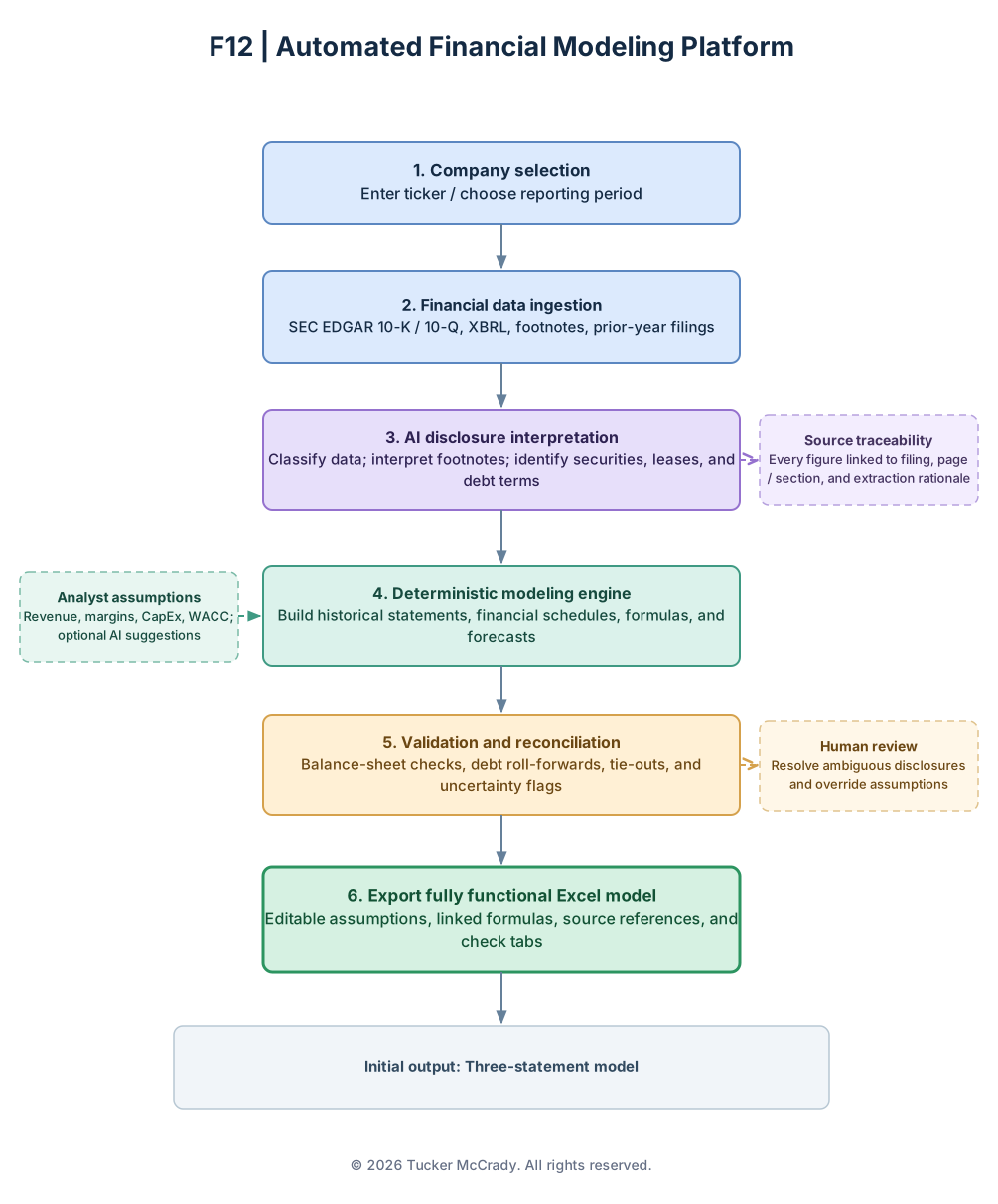
How I’m thinking about the architecture now. Select the diagram to read it at full size.
The goal is not to produce a spreadsheet that looks correct. It’s to produce a model whose calculations, assumptions, and underlying data can be independently verified.
If F12 can solve even part of that problem reliably, I think it becomes something considerably more valuable than the application I first had in mind.